
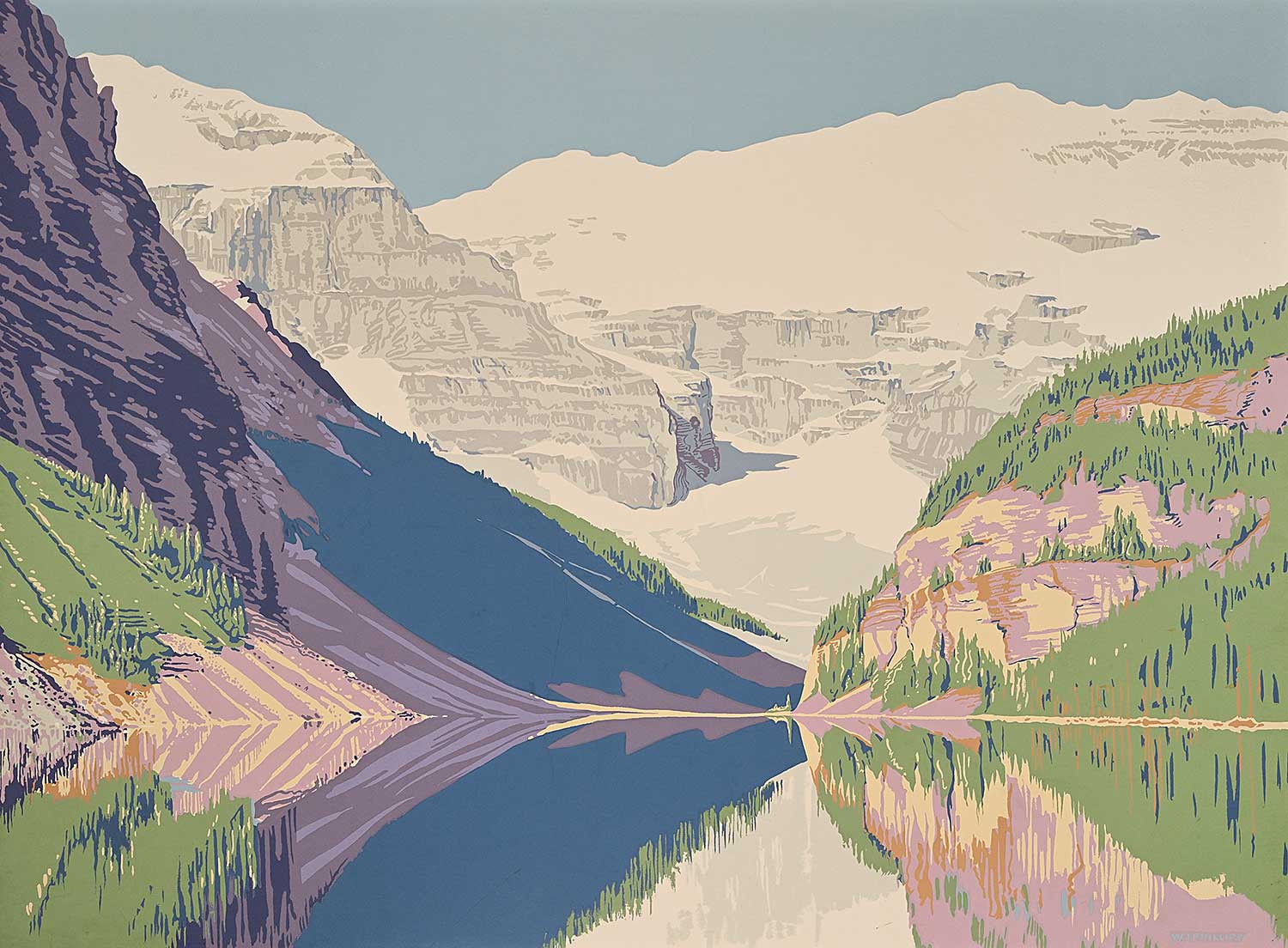
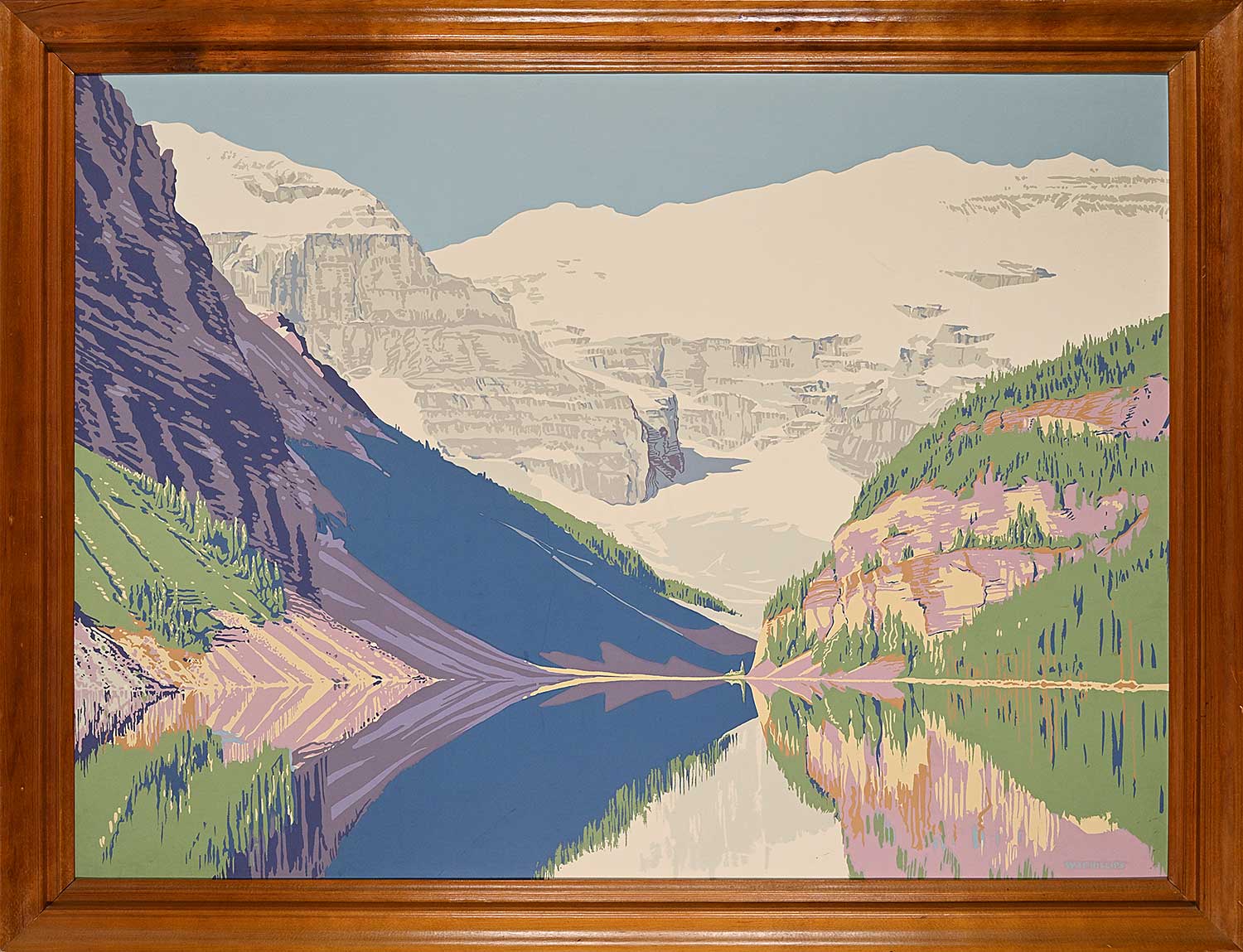
Artist Walter Joseph Phillips
Title Victoria Glacier
Media colour silkscreen on paper board
Dated
1953 -57
Size 29 x 39 in. / 73.7 x 99.1 cm.
Frame Size 33.75 x 44 x 1.25 in.
Estimate $900 - $1,200
Notes
signed in screen lower left; framed; minor scratching and surface dirt noted throughout
Reference
printed by Sampson-Matthews Limited; illustrated on page 178 in Art for War and Peace: How a Great Art Project Helped Canada Discover Itself, by Ian Sigvaldason and Scott Steedman, published by Read Leaf, 2015; Phillips contributed two designs to the Sampson-Matthews silkscreen program, Valley of the Ten Peaks and Victoria Glacier
Provenance
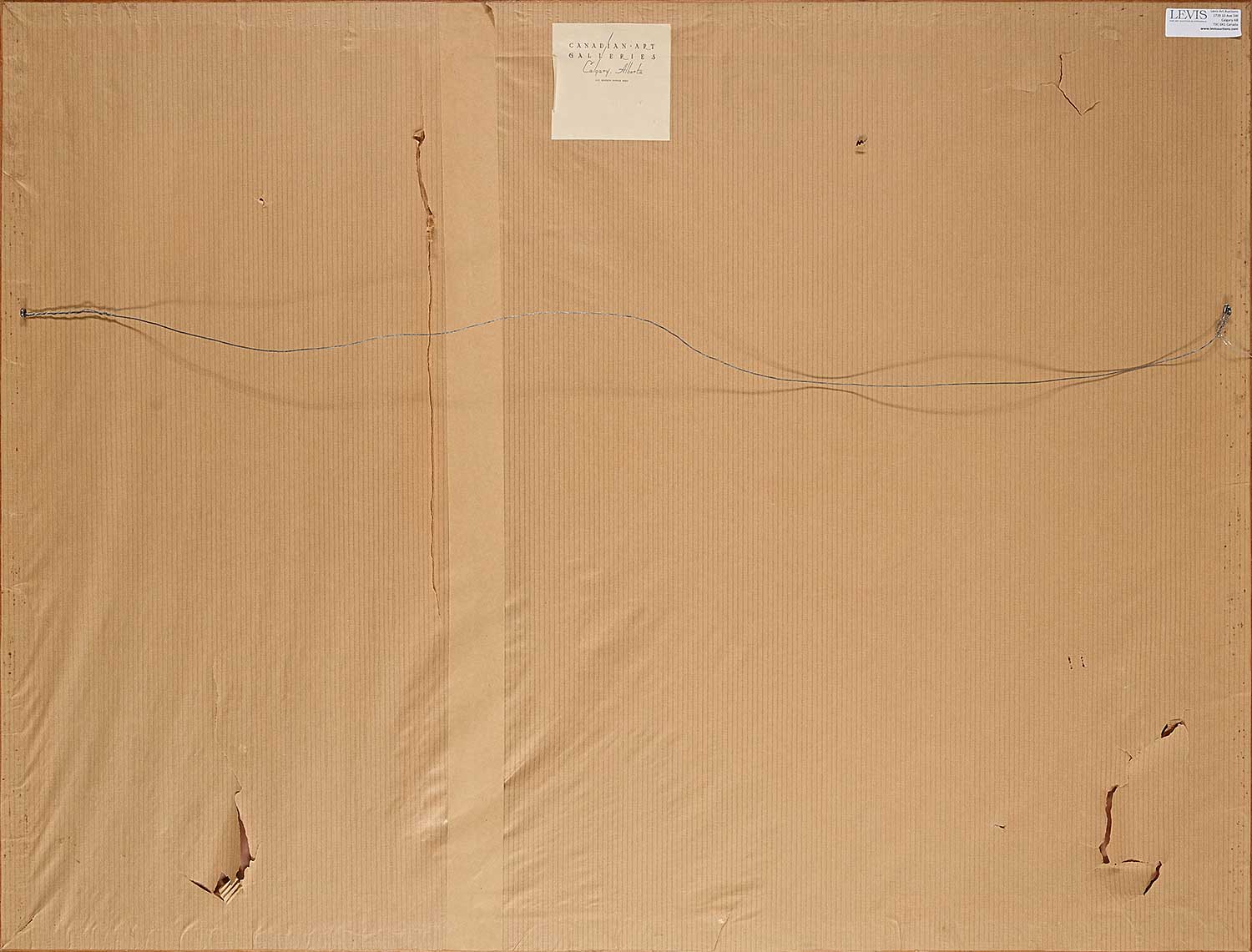
Canadian Art Galleries, Calgary, label verso; private collection, Calgary
Biographical Information
Walter Joseph Phillips ~ [1884-1963] Canadian ASA, CPE, CSPWC, MSA, RCA
Phillips was born in Barton-on-Humber, Lincolnshire, England, in 1884. He attended Bourne College where he won a scholarship in Mathematics. He spent the scholarship money on one afternoon a week at the Birmingham School of Art. For a few years he was a commercial and free-lance artist in England. In 1908, he became the Art Master at Bishop Woodworth school in Salisbury. Here he began to paint watercolours of varied subjects, such as figure-studies, portraits and still-life. After immigrating to Winnipeg with his wife in 1913, his main subjects were the Lake of the Woods, the prairies, the Rocky Mountains, and the pacific coast. Phillips continued with watercolour, and after briefly trying etching, discovered a passion for colour woodcut. He returned to England for a year in 1925 and there, through Y. Ushibara, he learned the Japanese method of sizing paper and registering it on the wood block. Japanese woodblock print was very influential for Phillips and other western artists in the nineteenth and twentieth century. In 1926, Phillips published The Technique of the Colour Wood-cut. He is credited for popularizing the style in Canada. In 1933 he was elected to a member of the Royal Canadian Academy and won the honorary mention in Warsaw Woodcut international. In 1940, he moved to Alberta and became an instructor at the Banff Summer School where he found the environment, nature, and interaction with students to be ‘in all ways stimulating’.
for more biographical information and examples of work see artist's website at wjphillips.ca
see
Walter J. Phillips, by Duncan Campbell Scott [Scott#], published by Ryerson Press, 1947;
Walter J. Phillips, A Selection of His Works and Thoughts, by Michael J. Gribbon, published by N.G.C., 1978;
The Tranquility and the Turbulence: The Life and Works of Walter J. Phillips, by Roger H. Boulet [MBL#], published by Loates, 1981;
Phillips in Print, edited by Douglas Cole and Maria Tippett, published by Manitoba Records Society, 1982;
Truth and Beauty in the Canadian Rockies, An Explorer's Guide to the Art of Walter J. Phillips, by Lisa Christensen, Fifth House Publishers, 2019;
biography and other examples in
N.G.C. Vol. III, by Robert Hubbard, pg. 247; A.G.O., by the A.G.O., pg. 365